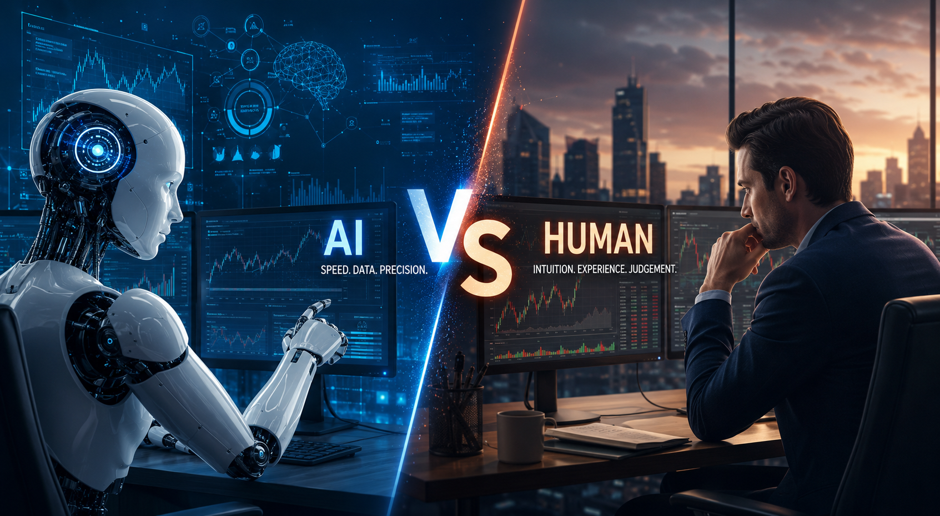
The question is particularly relevant in fast-growing financial hubs such as Dubai, Abu Dhabi, Sharjah, and other UAE markets where technology adoption continues to accelerate across industries. Investors are no longer asking whether artificial intelligence can participate in trading; they are asking whether AI can outperform experienced human traders and whether humans still have a meaningful role in modern financial decision-making.
For organisations and investors exploring advanced trading technologies, understanding the strengths and limitations of both approaches is critical. Companies such as Oceano Apex recognise that successful market participation increasingly depends on combining technological innovation with informed human oversight. While AI has undoubtedly transformed the speed and efficiency of trading, the complete picture is far more nuanced than a simple battle between humans and machines.
Understanding the Evolution of Modern Trading
Trading has undergone multiple technological revolutions. Markets that once relied on telephone orders and physical trading floors now execute millions of transactions electronically every second. The introduction of algorithmic trading marked a significant milestone, allowing predefined rules to automate buying and selling decisions based on specific market conditions.
The Rise of Algorithmic and AI-Powered Trading
Artificial intelligence has taken automation several steps further. Traditional algorithms follow fixed instructions, but AI systems can analyse historical patterns, process news sentiment, identify market anomalies, and continuously refine predictive models based on new information. These capabilities have enabled financial institutions to execute strategies that would be impossible for human traders alone.
AI-powered systems can monitor thousands of securities simultaneously, assess correlations across global markets, and react to changing conditions within milliseconds. In highly liquid markets, such speed provides a significant advantage. Large hedge funds and financial institutions increasingly invest in AI-driven technologies because they can uncover opportunities hidden within massive datasets that exceed human analytical capacity.
The growing accessibility of AI has also expanded opportunities for smaller investors. Trading platforms increasingly incorporate machine learning tools, predictive analytics, and automated strategy recommendations. This democratisation of technology means that AI is no longer reserved exclusively for large institutions.
The Continued Relevance of Human Decision-Making
Despite remarkable technological advancements, human traders continue to play an essential role in financial markets. Markets are influenced by economic policies, geopolitical developments, investor sentiment, regulatory changes, and countless unpredictable events. While AI can analyse data efficiently, understanding broader context often requires human judgement.
Experienced traders draw upon years of market exposure, industry knowledge, and practical experience when evaluating opportunities. They can interpret subtle developments that may not be immediately visible in historical datasets. Human expertise becomes particularly valuable when markets encounter unprecedented situations where past patterns provide limited guidance.
The continued presence of successful discretionary traders demonstrates that technology alone does not guarantee superior performance. Instead, success often depends on the ability to combine analytical tools with informed decision-making.
What AI Brings to the Trading World
Artificial intelligence offers several advantages that have fundamentally changed how trading operates. These strengths explain why AI adoption continues to expand across financial institutions worldwide.
Speed, Automation and Data Processing
Perhaps the most obvious advantage of AI is speed. Human traders cannot analyse thousands of data points simultaneously or execute transactions within microseconds. AI systems can process vast streams of information almost instantly, enabling rapid responses to changing market conditions.
This capability is especially valuable in high-frequency trading environments where small timing differences can significantly impact profitability. AI can continuously monitor price movements, economic indicators, company announcements, and global news sources without interruption. Unlike humans, it does not require rest, making it capable of operating around the clock across international markets.
Automation also improves consistency. Human decision-making can vary based on stress, fatigue, or emotional influences. AI follows predefined models and parameters, ensuring consistent execution regardless of external factors.
Pattern Recognition at Scale
One of AI's most powerful capabilities is identifying patterns hidden within large datasets. Financial markets generate enormous volumes of information every day. Human traders can only review a fraction of this data, whereas AI systems can evaluate millions of data points simultaneously.
Machine learning models excel at discovering relationships between variables that might otherwise remain unnoticed. These systems can analyse historical pricing behaviour, trading volume patterns, macroeconomic indicators, and alternative data sources to generate insights.
This pattern recognition capability allows AI to identify potential opportunities earlier and more consistently than manual analysis alone. As financial data continues to grow exponentially, this advantage becomes increasingly significant.
Strengths That Human Traders Still Possess
Although AI excels in speed and scale, human traders retain important advantages that technology has yet to replicate fully.
Market Intuition and Contextual Understanding
Financial markets are not purely mathematical systems. They are influenced by human behaviour, political decisions, regulatory changes, and unexpected events. Human traders often rely on intuition developed through years of experience navigating different market cycles.
This intuition is not merely guesswork. It reflects accumulated knowledge, pattern recognition developed through experience, and an understanding of factors that may not appear directly within datasets. Experienced traders can assess market narratives, investor psychology, and emerging trends in ways that remain challenging for AI systems.
For example, when governments announce unexpected policy changes or geopolitical tensions arise, human traders can evaluate broader implications beyond historical precedents. Such contextual interpretation often influences market outcomes significantly.
Adaptability During Unpredictable Events
AI systems perform best when operating within environments that resemble their training data. When entirely new situations emerge, models may struggle to generate reliable predictions.
Human traders possess a unique ability to adapt during unprecedented circumstances. During major financial disruptions, global pandemics, or geopolitical crises, historical data may provide limited guidance. Human judgement becomes particularly valuable in assessing risks, evaluating uncertainty, and making strategic decisions under unfamiliar conditions.
Markets frequently reward flexibility. Human traders can modify assumptions, incorporate new information rapidly, and challenge existing strategies when circumstances change dramatically. This adaptability remains one of the strongest arguments for maintaining human involvement in trading decisions.
AI vs Human Traders Across Different Market Conditions
The relative strengths of AI and human traders often depend on the market environment. Different conditions favour different approaches.
Performance in Stable Markets
In relatively stable market conditions, AI systems frequently demonstrate exceptional effectiveness. Predictable environments provide abundant historical data for training models and identifying recurring patterns. AI can execute strategies consistently, minimise delays, and optimise trade execution efficiency.
During periods of low volatility, algorithmic systems often outperform manual trading because they eliminate emotional decision-making and react faster to subtle market signals. This explains why many institutions rely heavily on automated systems for routine market operations.
The scalability of AI also becomes advantageous in stable environments. Systems can manage numerous assets simultaneously without sacrificing performance quality.
Performance During Volatility and Crises
Volatile markets create a more complex picture. Sudden shifts in sentiment, regulatory announcements, or unexpected events can disrupt historical relationships upon which AI models depend.
Human traders may perform better during these periods because they can incorporate qualitative information and reassess assumptions quickly. Their ability to interpret context and evaluate evolving situations can provide advantages when traditional patterns break down.
The strongest results often emerge when AI provides analytical support while human professionals maintain strategic oversight. This combination helps balance computational power with practical judgement.
The Role of Psychology in Trading Success
Trading psychology remains one of the most significant factors influencing investment outcomes. Understanding how emotions affect decision-making is essential when comparing AI and human performance.
Human Emotions as a Strength and Weakness
Emotions can undermine trading performance through fear, greed, overconfidence, and panic. Many trading mistakes occur because individuals deviate from well-defined strategies during periods of market stress.
Yet emotions are not always detrimental. Human empathy, intuition, and behavioural understanding contribute to broader market awareness. Experienced traders often recognise shifts in investor sentiment before they become evident in quantitative data.
This dual nature makes psychology both an advantage and a challenge. Successful traders learn to manage emotions rather than eliminate them entirely.
AI's Emotion-Free Decision Framework
Artificial intelligence does not experience fear, excitement, or hesitation. Decisions are based solely on programmed logic, statistical probabilities, and learned patterns. This objectivity reduces many behavioural biases that affect human traders.
However, the absence of emotion does not guarantee perfection. AI lacks genuine understanding of human motivations and societal dynamics. It may identify statistical relationships without comprehending the underlying reasons driving market behaviour.
The ideal solution often involves combining AI's objectivity with human insight. This partnership can mitigate emotional biases while preserving contextual understanding.
Why the Future Belongs to Hybrid Trading Models
The debate between AI and human traders is increasingly shifting toward collaboration rather than competition. Industry leaders recognise that each approach offers unique strengths.
Human Oversight with AI Intelligence
Hybrid trading models leverage AI for data analysis, pattern recognition, risk monitoring, and execution while retaining human oversight for strategic decision-making. This structure combines computational efficiency with practical expertise.
Human professionals can validate AI-generated insights, identify unusual market conditions, and make judgement calls when uncertainty increases. Meanwhile, AI handles repetitive tasks, processes large datasets, and highlights opportunities that might otherwise be overlooked.
This partnership creates a more balanced approach capable of adapting to diverse market environments. Rather than replacing traders, AI increasingly serves as an advanced decision-support tool.
Opportunities for UAE Investors and Businesses
The UAE continues to position itself as a global centre for innovation, fintech, and digital transformation. Investors and organisations in Dubai, Abu Dhabi, Sharjah, Ajman, Ras Al Khaimah, and Fujairah are increasingly exploring AI-powered financial technologies to improve efficiency and competitiveness.
Businesses that embrace responsible AI adoption while maintaining strong governance frameworks will likely gain strategic advantages. The ability to combine technological innovation with experienced leadership can support better investment decisions, enhanced risk management, and improved operational performance.
For organisations seeking to navigate this evolving landscape, working with experienced partners can help ensure that technology implementation aligns with broader business objectives.
Partner with Oceano Apex for Smarter Trading Solutions
As financial markets continue to evolve, choosing the right approach to technology adoption becomes increasingly important. The question is no longer whether AI or humans are superior in every situation. The real competitive advantage comes from understanding how both can work together effectively.
Oceano Apex helps businesses and investors explore innovative solutions that combine advanced technology with informed strategic guidance. Whether your organisation is evaluating AI-powered analytics, digital transformation initiatives, or broader wealth management opportunities, having a trusted partner can make a significant difference.
Companies across Dubai, Abu Dhabi, Sharjah, Ajman, Ras Al Khaimah, and the wider UAE can benefit from expert insights tailored to their unique objectives and operational requirements. To discuss how modern technologies can support your business goals, contact Oceano Apex today at +971 585 015 666 and discover practical strategies designed for long-term success.
Frequently Asked Questions
- Q1: What is the biggest advantage of AI in trading?
- Ans: AI's greatest advantage is its ability to process vast amounts of data rapidly, identify patterns, and execute trades with exceptional speed and consistency.
- Q2: Can AI completely replace human traders?
- Ans: No. While AI excels in data analysis and automation, human judgement remains valuable for interpreting context, managing uncertainty, and adapting to unprecedented situations.
- Q3: Do professional traders use AI?
- Ans: Yes. Many institutional investors, hedge funds, and financial firms use AI-powered tools to support analysis, execution, and risk management.
- Q4: Is AI trading suitable for UAE investors?
- Ans: AI-powered trading technologies can offer significant benefits for UAE investors when implemented responsibly and combined with appropriate oversight and risk management.
- Q5: Which performs better during market crises?
- Ans: Human traders often have advantages during unprecedented events because they can evaluate context and adapt strategies beyond historical patterns used by AI models.
- Q6: What is a hybrid trading model?
- Ans: A hybrid model combines AI-driven analysis and automation with human supervision and strategic decision-making to leverage the strengths of both approaches.
- Q7: How can businesses benefit from AI-powered financial technologies?
- Ans: Businesses can improve efficiency, enhance data-driven decision-making, strengthen risk management processes, and identify opportunities more effectively through AI-powered solutions.