
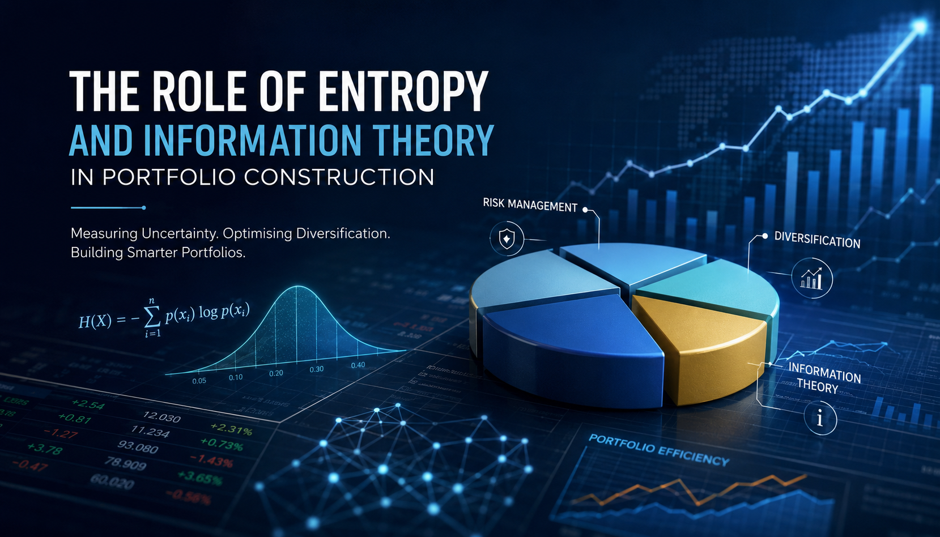
Portfolio construction has evolved dramatically over the past few decades. Investors no longer rely solely on traditional diversification techniques or historical averages to manage risk and optimise returns. As financial markets become increasingly interconnected, complex, and data-driven, modern portfolio managers are exploring advanced mathematical frameworks that can better capture uncertainty and market dynamics. Among these frameworks, entropy and information theory have emerged as powerful concepts that offer fresh perspectives on risk management, asset allocation, and portfolio optimisation.
Originally developed within physics and communication science, entropy and information theory now play a significant role in quantitative finance. These concepts help investors understand uncertainty, measure diversification more effectively, and make decisions in environments where complete information is unavailable. In a global financial hub such as the UAE, where investors in Dubai, Abu Dhabi, Sharjah, and other emirates increasingly seek sophisticated wealth management solutions, entropy-based approaches provide valuable tools for constructing resilient portfolios.
Businesses and investors looking for advanced financial strategies often work with experienced advisory firms such as Oceano Apex, which emphasise data-driven decision-making and modern portfolio management principles. Understanding how entropy and information theory influence investment strategies can help investors navigate uncertainty more effectively while maintaining long-term financial objectives.
Understanding Modern Portfolio Construction
Portfolio construction refers to the process of selecting and allocating assets in a way that aligns with an investor’s goals, risk tolerance, and investment horizon. Traditional portfolio theory, pioneered by economist Harry Markowitz, focuses on balancing risk and return through diversification. The framework relies heavily on expected returns, variances, and correlations among assets.
While modern portfolio theory remains influential, financial markets today present challenges that extend beyond historical statistical relationships. Market shocks, geopolitical events, technological disruptions, and changing investor behaviour often create conditions that historical data alone cannot fully explain. As a result, portfolio managers increasingly seek alternative methods for evaluating uncertainty and making allocation decisions.
Traditional approaches often assume that future market behaviour resembles historical patterns. However, financial markets are adaptive systems influenced by countless variables. Investors therefore require models that can account for incomplete information and evolving market conditions. This need has contributed to growing interest in entropy-based methodologies, which focus on measuring uncertainty directly rather than relying exclusively on historical variance and covariance calculations.
Why Traditional Portfolio Models Have Limitations
Conventional portfolio models depend heavily on assumptions regarding expected returns and correlations. Small estimation errors can significantly affect portfolio outcomes. When market conditions change unexpectedly, these assumptions may become unreliable.
Information theory introduces a different perspective by focusing on uncertainty itself. Instead of attempting to predict every possible market movement, entropy-based approaches recognise that uncertainty is an inherent feature of financial systems. This shift in perspective can lead to more robust portfolio construction strategies capable of adapting to changing market environments.
What Is Entropy in Finance?
Entropy is commonly described as a measure of uncertainty, randomness, or disorder within a system. In finance, entropy quantifies the degree of unpredictability associated with investment outcomes, asset distributions, or market behaviour.
The concept originated in thermodynamics before being adapted by mathematician and engineer Claude Shannon, whose work laid the foundation for modern information theory. Shannon entropy measures the amount of uncertainty contained within a set of possible outcomes. When applied to investments, entropy can help quantify how diversified a portfolio truly is and how uncertain future returns may be.
A portfolio concentrated in only a few assets generally exhibits lower entropy because outcomes depend heavily on those specific investments. By contrast, a well-diversified portfolio distributed across multiple assets tends to exhibit higher entropy, reflecting broader exposure and reduced concentration risk.
The Origin of Entropy from Information Theory
Information theory studies how information is measured, transmitted, and processed. Shannon introduced entropy as a mathematical measure of information content. The greater the uncertainty surrounding an outcome, the more information is gained when that outcome becomes known.
In financial markets, investors continuously process information from economic reports, corporate earnings, interest rate decisions, and geopolitical developments. Information theory provides a framework for understanding how this information influences expectations and investment decisions.
How Entropy Measures Uncertainty
Entropy allows investors to evaluate uncertainty objectively. Rather than focusing exclusively on volatility, entropy examines the distribution of probabilities across potential outcomes.
For example, if one investment dominates a portfolio allocation, uncertainty may be relatively low because portfolio performance depends heavily on a single source. If allocations are distributed more evenly across diverse assets, uncertainty increases while concentration risk decreases. This balance often contributes to stronger portfolio resilience during periods of market stress.
Information Theory and Investment Decision-Making
Information is one of the most valuable resources in financial markets. Every investment decision reflects an attempt to transform information into actionable insight. Information theory helps quantify the value and reliability of information while accounting for uncertainty.
Investors face constant challenges when interpreting vast amounts of data. Economic indicators, corporate announcements, market sentiment, and global events all influence asset prices. Information theory offers mathematical tools that help distinguish meaningful signals from background noise.
Information As a Quantifiable Asset
Financial professionals increasingly treat information as a measurable resource. Better information can improve forecasting accuracy, reduce uncertainty, and enhance decision-making. Information theory provides metrics that allow analysts to evaluate how much new information changes existing expectations.
When investors receive new data, they update their beliefs regarding future market conditions. Information-theoretic models help quantify these updates and determine how significantly new information should influence portfolio allocations.
Reducing Information Asymmetry in Markets
Markets often contain information asymmetries, where some participants possess more knowledge than others. Information theory helps identify inefficiencies arising from unequal information distribution.
By incorporating broader datasets and advanced analytical techniques, portfolio managers can reduce uncertainty and improve allocation decisions. This approach is particularly valuable in rapidly evolving markets where traditional forecasting methods may struggle to keep pace with new information.
Entropy-Based Portfolio Construction Methods
Entropy has inspired several portfolio construction methodologies designed to improve diversification and manage uncertainty more effectively. These approaches often complement traditional optimisation techniques rather than replace them entirely.
Maximum Entropy Portfolio Approach
The maximum entropy principle suggests selecting the probability distribution that incorporates known information while making the fewest additional assumptions. In portfolio management, this principle helps avoid overconfidence in forecasts.
Rather than concentrating allocations based on uncertain return estimates, maximum entropy portfolios distribute investments in a manner that reflects available information without introducing unnecessary bias. This approach often results in more balanced portfolios capable of adapting to changing market conditions.
Entropy Pooling Techniques
Entropy pooling combines multiple market views and scenarios into a unified framework. Portfolio managers frequently possess different expectations regarding economic growth, inflation, interest rates, or asset performance.
Entropy pooling allows these views to be incorporated systematically while preserving consistency with existing market information. This creates flexible portfolio models that can integrate expert opinions without sacrificing analytical rigour.
Risk Allocation Applications
Entropy-based methods also improve risk allocation. Traditional diversification often focuses on asset counts or sector exposures. Entropy measures diversification more comprehensively by examining how risk is distributed throughout the portfolio.
This enables investors to identify hidden concentrations and develop more balanced allocation strategies that align with long-term objectives.
Benefits of Using Entropy in Portfolio Management
Entropy offers several advantages that make it increasingly attractive within modern investment management.
Diversification Beyond Correlation
Traditional diversification relies heavily on correlations among assets. However, correlations can change rapidly during market crises. Assets that appear uncorrelated during stable periods may become highly correlated during periods of stress.
Entropy-based diversification evaluates portfolio structure from a broader perspective. It measures allocation balance directly rather than depending solely on correlation estimates. This often leads to portfolios that maintain stronger diversification characteristics during volatile market environments.
Improved Risk Assessment
Entropy provides additional insight into portfolio risk by focusing on uncertainty rather than volatility alone. While volatility measures price fluctuations, entropy captures broader dimensions of uncertainty that influence investment outcomes.
Investors who incorporate entropy into risk management frameworks often gain a deeper understanding of portfolio vulnerabilities. This can support more informed decisions regarding asset allocation, rebalancing, and long-term investment strategy.
Applications in UAE Investment Markets
The UAE has established itself as a major regional financial centre, attracting institutional investors, family offices, wealth managers, and high-net-worth individuals from around the world. As investment opportunities expand across sectors and asset classes, sophisticated portfolio construction techniques become increasingly valuable.
Investors in Dubai, Abu Dhabi, Sharjah, Ajman, Ras Al Khaimah, and Fujairah face diverse market opportunities spanning equities, real estate, fixed income, private markets, and alternative investments. Managing these exposures effectively requires advanced approaches capable of addressing uncertainty and complexity.
Relevance for Institutional and Private Investors
Institutional investors often manage large portfolios with complex risk profiles. Entropy-based methodologies help these organisations optimise diversification while maintaining strategic objectives.
Private investors also benefit from entropy principles. By understanding uncertainty and information flows, individuals can make more informed decisions regarding asset allocation and long-term wealth preservation.
Portfolio Strategies Across Dubai and Abu Dhabi
Dubai and Abu Dhabi continue to attract international capital due to their strong infrastructure, regulatory frameworks, and economic diversification initiatives. Investors operating within these markets increasingly seek advanced analytical methods capable of supporting evidence-based investment decisions.
Entropy and information theory provide valuable frameworks for evaluating investment opportunities while managing uncertainty in a disciplined manner.
Challenges and Considerations
Despite their advantages, entropy-based methods are not without challenges. These models require sophisticated mathematical expertise and reliable data inputs. Incorrect assumptions or poor-quality data can reduce effectiveness.
Entropy should therefore be viewed as a complementary tool rather than a standalone solution. Successful portfolio construction typically combines multiple analytical approaches, including fundamental analysis, risk management techniques, economic research, and quantitative modelling.
Investors should also recognise that no methodology can eliminate uncertainty entirely. Financial markets remain inherently unpredictable. The goal is not to remove uncertainty but to manage it intelligently through informed decision-making and disciplined portfolio construction.
How Oceano Apex Supports Data-Driven Investment Strategies
As financial markets continue evolving, investors increasingly require partners capable of navigating complexity and uncertainty. Oceano Apex understands the importance of combining traditional investment principles with modern analytical techniques to support effective portfolio management.
By embracing data-driven frameworks, advanced risk analysis, and evidence-based decision-making, Oceano Apex helps investors evaluate opportunities within dynamic market environments. Whether managing diversified investment portfolios or exploring strategic financial planning initiatives, a structured approach to uncertainty can significantly enhance long-term outcomes.
The integration of concepts such as entropy and information theory reflects the broader shift toward more sophisticated investment methodologies. Investors seeking greater resilience, improved diversification, and enhanced risk management can benefit from strategies that acknowledge uncertainty while remaining focused on long-term objectives.
Partner with Oceano Apex for Smarter Portfolio Construction
Financial markets reward preparation, discipline, and informed decision-making. Understanding the role of entropy and information theory can help investors develop portfolios that are better equipped to withstand uncertainty while pursuing sustainable growth.
Oceano Apex provides professional guidance for investors seeking advanced portfolio construction strategies and data-driven financial solutions. Whether you are an institutional investor, business owner, family office, or private client in Dubai, Abu Dhabi, Sharjah, Ajman, Ras Al Khaimah, or Fujairah, expert support can make a meaningful difference in achieving your financial goals.
To learn more about tailored investment solutions and portfolio management strategies, contact Oceano Apex today at +971 585 015 666.
Frequently Asked Questions
- Q1: What is entropy in portfolio construction?
- Ans: Entropy is a mathematical measure of uncertainty and diversification. In portfolio construction, it helps investors evaluate how evenly investments are distributed and how much uncertainty exists within the portfolio.
- Q2: How does information theory apply to investing?
- Ans: Information theory helps quantify uncertainty and assess how new information affects investment decisions. It supports more informed portfolio management and risk assessment.
- Q3: Is entropy better than traditional diversification?
- Ans: Entropy is not necessarily a replacement for traditional diversification. Instead, it complements conventional methods by providing additional insight into uncertainty and portfolio balance.
- Q4: Why is entropy useful for risk management?
- Ans: Entropy captures broader dimensions of uncertainty beyond simple volatility measures. This helps investors identify concentration risks and improve diversification strategies.
- Q5: Can individual investors benefit from entropy-based approaches?
- Ans: Yes. Individual investors can apply entropy concepts to understand diversification, evaluate uncertainty, and build more resilient portfolios.
- Q6: Are entropy models widely used in professional finance?
- Ans: Many quantitative investment firms, asset managers, and institutional investors incorporate entropy-based methods as part of broader portfolio optimisation and risk management frameworks.
- Q7: Why is entropy relevant in UAE financial markets?
- Ans: The UAE's diverse investment landscape creates opportunities across multiple asset classes and sectors. Entropy-based approaches help investors manage uncertainty while maintaining diversified portfolios.